







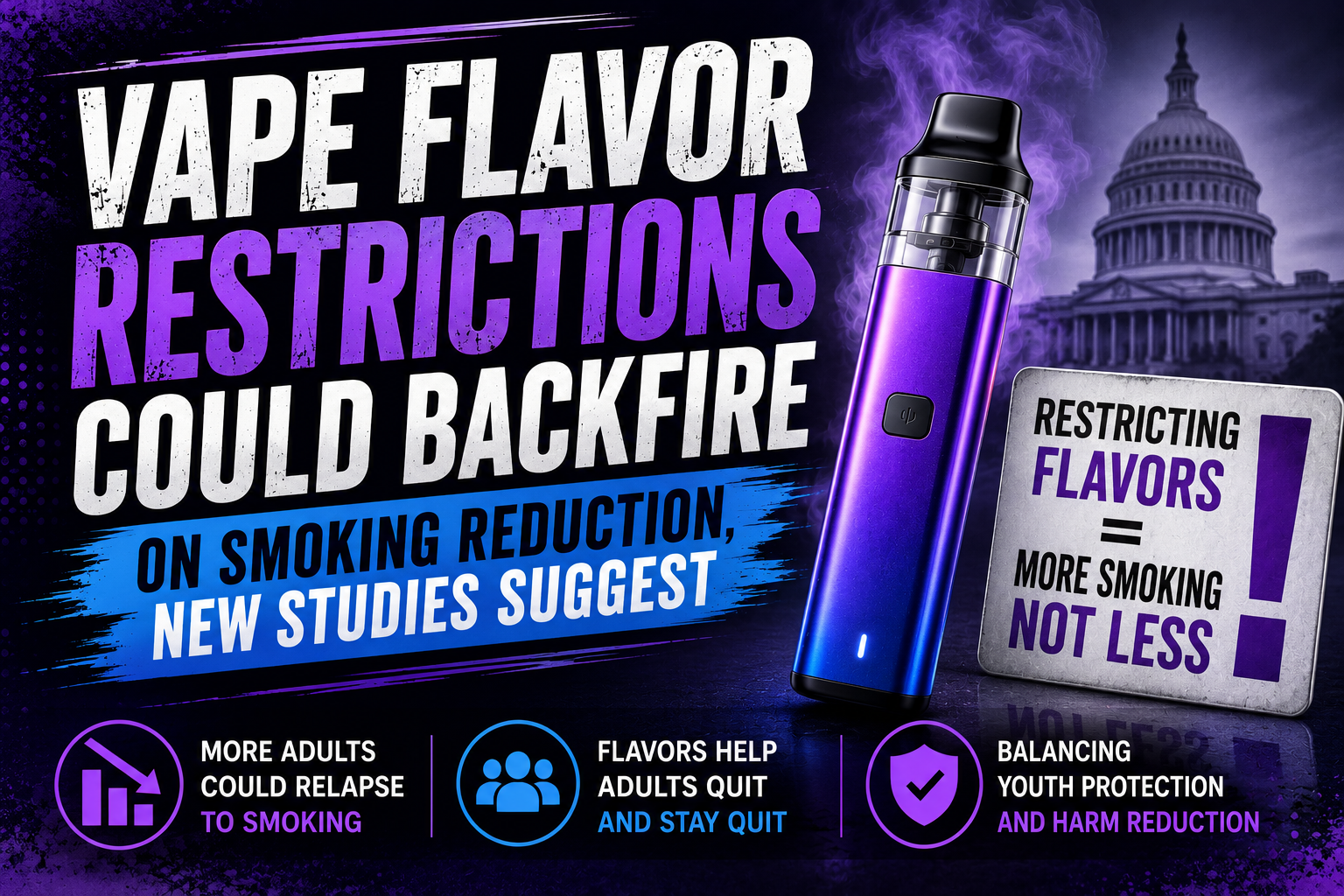
Vape Flavor Restrictions Could Backfire on Smoking Reduction, New Studies Suggest
As governments around the world continue debating restrictions on flavored vaping products, two newly published studies are adding important context to the conversation — especially when it comes to adult smoking cessation.
A UK policy model and a separate U.S. randomized clinical trial both suggest that flavored vaping products may play a larger role in helping adults move away from cigarettes than many policymakers acknowledge.
The findings come at a time when lawmakers increasingly propose limiting vape products to only tobacco, menthol, or unflavored options to reduce youth vaping. But according to these new analyses, those restrictions could carry unintended consequences for adult smokers trying to quit combustible cigarettes.
UK Model Estimates More Than 841,000 Adults Avoid Smoking Because of Flavored Vapes
A study published in Health Research Policy and Systems examined the potential impact of restricting vape flavors in the United Kingdom.
Using population data from sources including Action on Smoking and Health surveys, the Smoking Toolkit Study, the Office for National Statistics, and updated evidence through November 2024, researchers created a policy model designed to estimate the potential public health tradeoffs of flavor restrictions.
The model estimated that approximately 841,302 smokers and former smokers in the UK currently do not smoke because flavored vaping products remain available.
By comparison, the same model estimated that:
- 125,034 non-smoking young people experiment with vaping because of flavors
- 48,764 of those individuals later smoke cigarettes under the assumptions used within the model
While the youth figures are concerning and continue to drive regulatory discussions, the model concluded that removing most vape flavors could ultimately have a net negative effect on adult smoking rates.
Researchers found that many adult vape users indicated they would either:
- smoke more cigarettes, or
- return to smoking entirely
if non-tobacco and non-menthol vape flavors disappeared from the market.
Among adult dual users and recent ex-smokers who quit using vapes, 59% said they would likely smoke more or relapse if flavors were removed. Even among long-term ex-smokers who vape, 11% said they could return to smoking tobacco.
Why Flavors Matter to Adult Smokers
For many adult consumers, flavors are not simply about novelty — they help separate vaping from the taste and experience of cigarettes.
That distinction matters.
Public health experts have increasingly recognized that adults who switch away from combustible cigarettes often prefer non-tobacco flavors because they reduce the sensory connection to smoking. Fruit, dessert, beverage, and mint flavors may help make cigarettes less appealing while improving the likelihood of long-term switching.
The UK analysis acknowledged that youth vaping remains a legitimate concern, but the model suggested that policymakers must weigh youth prevention efforts against the risk of increasing adult cigarette smoking and relapse.
Importantly, the study authors also noted several limitations:
- the model estimates anticipated behavior rather than observed post-ban outcomes
- it does not capture every possible behavioral shift
- the relationship between vaping and later smoking may involve shared risk factors rather than a direct “gateway” effect alone
Even with those limitations, the model’s conclusion was clear: restricting flavored vape products could produce unintended public health consequences if adult smoking rates rise as a result.
Separate U.S. Trial Found Vapes Helped Smokers Across Nearly Every Group

A second study published in Addictive Behaviors looked at whether providing vaping products helped different types of smokers equally.
Researchers analyzed data from a large U.S. randomized clinical trial involving 638 adult smokers. Participants were either:
- provided with a four-week supply of tank-style vaping products, or
- placed into a control group without products
Participants were then followed for 24 weeks.
The analysis examined several smoking-related outcomes, including:
- making a quit attempt
- reducing cigarette consumption by at least 50%
- achieving seven-day smoking abstinence
Researchers tested the results across more than 10 demographic and smoking-history categories, including:
- age
- sex
- race
- education
- nicotine dependence
- mental health diagnoses
- previous quit attempts
- motivation to quit smoking
The results were remarkably consistent.
Researchers found that the relative benefit of vaping products did not differ significantly across the groups studied.
That included smokers with:
- low motivation to quit
- higher nicotine dependence
- mental health diagnoses
- prior failed quit attempts
Even smokers who initially reported low motivation to quit still showed meaningful reductions in cigarette consumption after being provided vaping products.
What This Means for Policymakers
Neither study claims vaping products are risk-free, nor do they suggest youth vaping concerns should be ignored.
But both studies reinforce a growing body of evidence showing that vaping products — particularly flavored options — may play a significant role in helping adults reduce or quit smoking combustible cigarettes.
The policy challenge is finding ways to reduce youth access without eliminating products that many adults rely on to remain smoke-free.
That balance becomes increasingly important as countries and states continue proposing broad flavor bans that could unintentionally push some adults back toward cigarettes.
As regulators debate the future of flavored nicotine products, these studies highlight an uncomfortable but important reality: policies designed to reduce vaping may not always reduce smoking.
And when combustible cigarettes remain widely available, policymakers may need to carefully consider whether removing lower-risk alternatives could ultimately create more harm than benefit.
Study Link
Read the full UK policy model study here.
Flavored Vapor Products are Not Available for purchase in the state of California


Leave a comment
This site is protected by hCaptcha and the hCaptcha Privacy Policy and Terms of Service apply.