
Posted by Alli Boughner on Sep 24th 2026
Vape Registry Laws Failed to Deliver Lasting Sales Reductions
The Bottom Line
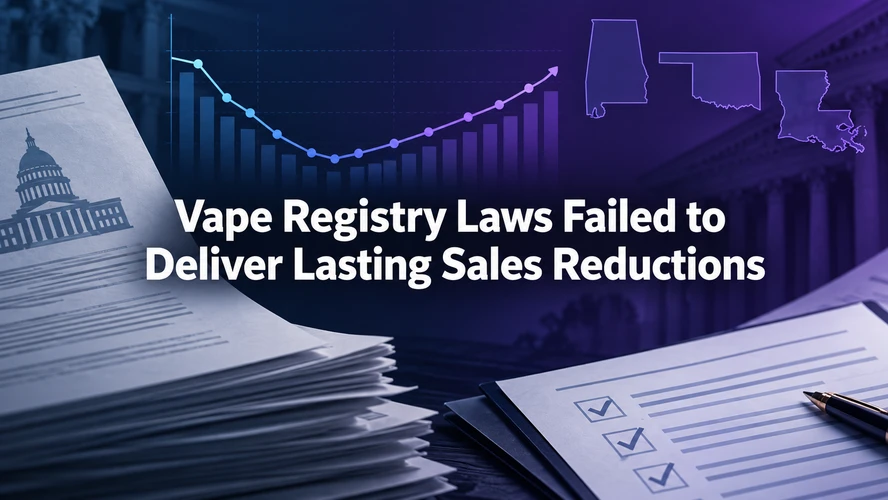
A new study published in JAMA Network Open found that e-cigarette product directory laws in Alabama, Oklahoma, and Louisiana did not produce sustained reductions in flavored vape sales. Alabama and Oklahoma showed no statistically significant overall change in nicotine sales or product availability after their directories were implemented. Louisiana recorded an initial decline, but sales rebounded within eight months and eventually surpassed predirectory levels.
That finding matters as more states adopt PMTA-based registries with promises that the laws will remove unauthorized products, reduce youth access, and bring order to the market. In the first three states to implement this model, the real-world results did not match those promises.
What Vape Registry Laws Are Supposed to Do
State vape registries, also called product directories, determine which vapor products may legally be sold within a state. Manufacturers generally must certify that a product has received FDA marketing authorization, has a qualifying premarket tobacco product application pending with FDA, or is covered by specified litigation or appeal provisions. Retailers are then prohibited from selling products that do not appear on the state list.
Supporters have presented these laws as a way to enforce federal marketing requirements at the state level. Critics have warned that the model relies heavily on manufacturer attestations, creates conflicting state-by-state product lists, burdens retailers and regulators, and can remove independent products without meaningfully eliminating the broader market for flavored vapor products.
The new study is the first known rigorous evaluation of whether these laws actually changed e-cigarette sales and product availability in the states where the registry model began.
How the Study Was Conducted
Researchers from the CDC Foundation analyzed Circana retail scanner data covering January 2021 through April 2025. The data included food, drug, mass merchandise, club, dollar, and convenience stores and represented approximately 90 percent of consumer packaged-goods dollar sales. Online retailers and tobacco and vape specialty stores were not included.
The analysis covered 1,904 state-month observations. Researchers compared Alabama, Oklahoma, and Louisiana with synthetic control states whose prepolicy sales trends were similar. The primary outcome was monthly per-capita nicotine sales, calculated from units sold, e-liquid volume, and nicotine concentration. Product availability was measured by the number of distinct universal product codes sold each month.
The researchers also adjusted for factors including e-cigarette taxes, unemployment, tobacco-control funding, cessation coverage, smoke-free laws, and COVID-19 cases. Because the study was observational, it identifies associations rather than proving that the registry laws alone caused every market change.
The Results by State
|
State |
Directory timing |
Sales finding |
Product availability |
|
Alabama |
May 2022 |
No significant overall association; per-capita nicotine sales rose descriptively from 47.8 mg before publication to 89.6 mg afterward. |
No significant association; distinct products rose descriptively from 910 to 1,414. |
|
Oklahoma |
October 2023 |
No significant overall association; per-capita nicotine sales rose descriptively from 45.0 mg to 59.3 mg. |
No significant overall association; products rose descriptively from 981 to 1,059. |
|
Louisiana |
November 2023 |
Initial decline followed by a rebound. Sales were no longer significantly different after eight months and exceeded predirectory levels by April 2025. |
Sustained average reduction of 53.55 percent, although fewer products did not produce a lasting sales decline. |
Alabama
Alabama was the earliest of the three states to publish a directory. The study found no significant association between the law and overall nicotine sales or product availability. Descriptively, per-capita nicotine sales increased from an average of 47.8 milligrams before directory publication to 89.6 milligrams afterward. The number of products sold also increased from 910 to 1,414, driven largely by flavored disposable products.
By April 2025, non-tobacco flavors represented 96.1 percent of sales, and products not listed on the directory accounted for 92.1 percent of per-capita nicotine sales. In other words, the directory existed, but the products it was supposed to exclude continued to dominate tracked retail sales.
Oklahoma
Oklahoma produced a similar result. Researchers found no significant overall association between directory publication and nicotine sales or product availability. Average per-capita nicotine sales increased descriptively from 45.0 milligrams before the directory to 59.3 milligrams afterward, while the number of available products increased from 981 to 1,059.
Non-tobacco flavors remained above 90 percent of sales and reached 93.6 percent by April 2025. Unlisted products accounted for 53.6 percent of nicotine sales. The study also found a statistically significant 21.74 percent increase in the availability of menthol prefilled cartridges relative to Oklahoma’s synthetic control.
Louisiana
Louisiana was the only state to show a clear initial decline. Per-capita nicotine sales fell after the directory was published, reaching a low of 16.9 milligrams in June 2024. Product availability also fell sharply. But the sales decline did not last.
By April 2025, per-capita nicotine sales had rebounded to 44.9 milligrams, above the predirectory level. The study found that the difference from the synthetic control was no longer statistically significant after eight months. Flavored disposable sales returned, while menthol prefilled cartridge sales—driven primarily by Vuse Alto—had increased and partially offset the earlier decline.
Louisiana did sustain a reduction in the number of products available, averaging 53.55 percent below the synthetic control. But the study cautioned that reducing the number of products is not the same as reducing total sales or improving public-health outcomes. By April 2025, 52.3 percent of Louisiana’s nicotine sales still came from products not listed on the directory.
The Most Important Finding
By April 2025, more than half of tracked nicotine sales in all three states came from products that were not listed on the applicable state directory. The unlisted shares were 92.1 percent in Alabama, 53.6 percent in Oklahoma, and 52.3 percent in Louisiana.
That exposes the central weakness in the registry model: publishing a list does not automatically remove unlisted products from stores. A registry is only as effective as the information used to build it, the enforcement behind it, and the state’s ability to monitor a fast-moving market. The researchers noted that no independent public source allows states to fully verify when a product entered the market, whether its PMTA remains pending, or whether an MDO or appeal changes its status.
Fewer Products Did Not Mean Lower Sales
Louisiana is especially important because it demonstrates the difference between shrinking product selection and reducing actual sales. The directory was associated with a major and lasting reduction in the number of distinct products sold, yet nicotine sales recovered. Consumers shifted among products, and the market consolidated around the products that remained readily available.
The authors warned that when product availability falls without a sustained decline in sales, the primary effect may be reduced competition that benefits major tobacco companies. That concern is particularly relevant to independent vapor businesses, which can lose lawful market access while large national brands gain share without producing the promised reduction in overall sales.
What This Means for Vape Businesses
- Registry laws should be evaluated by measurable outcomes, not by the number of products removed from a list.
- Retailers remain exposed to compliance risk when state directories change frequently and do not match FDA’s own public authorization information.
- Manufacturer attestations and incomplete federal data make accurate state-level verification difficult.
- Enforcement may temporarily disrupt a market without creating a lasting change in consumer demand.
- A reduction in independent products can shift sales toward large tobacco-company brands rather than meaningfully reduce total nicotine sales.
- States considering new registries should account for administrative costs, enforcement capacity, retailer burdens, and the evidence from early-adopting states before repeating the same model.
Important Study Limitations
The findings should be interpreted carefully. Scanner data did not include online sales or tobacco and vape specialty stores, so the analysis does not capture the entire market. Product directory status was determined using lists accessed in July 2026 because historical listing dates were incomplete, and products were coded at the brand level. Those choices may have overestimated the share of listed-product sales. The analysis also cannot establish whether changes resulted from the laws themselves, enforcement intensity, retailer behavior, tax changes, or shifts into sales channels not captured by Circana.
Those limitations do not erase the central result: in the retail channels the researchers could measure, the first three state registries did not produce sustained reductions in flavored e-cigarette sales.
The Policy Lesson
For years, registry bills have been sold as straightforward enforcement tools. This study shows that the reality is far more complicated. Alabama and Oklahoma experienced no measurable overall reduction. Louisiana temporarily reduced sales and substantially narrowed product availability, but sales returned within months. Unlisted products continued to represent the majority of tracked sales in every state.
States now considering or implementing registries should not assume that copying the earliest laws will deliver different results. Lawmakers should require transparent reporting, examine whether enforcement is feasible, measure sales rather than simply count listed products, and consider who gains when independent competition disappears but overall sales remain.