
Posted by Alli Boughner on Nov 25th 2026
Switching From Smoking to Vaping Lowers Toxicant Exposure
The biggest number in a new review of smoking and vaping is 92%. The most important word is completely.
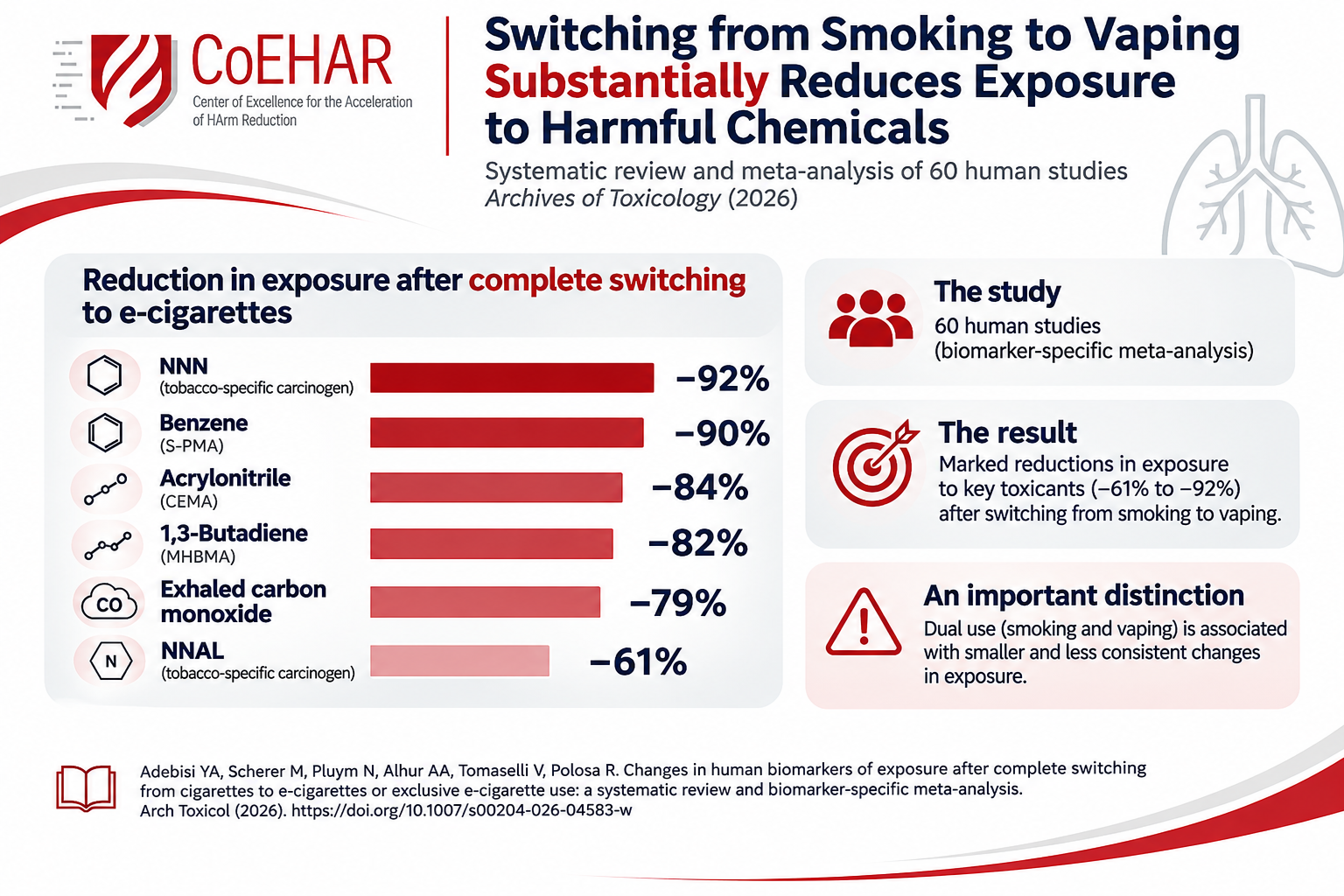
Researchers found that people who replaced cigarettes entirely with e-cigarettes had substantially lower levels of several chemicals and exposure markers associated with smoking. Across the 10 biomarkers the researchers pooled, the estimated reductions ranged from 61% to 92% compared with cigarette smoking. People who continued to smoke while vaping generally saw smaller and less consistent changes.
That distinction can get lost in the broader argument about vaping. For an adult who would otherwise keep smoking, the practical question is what changes when cigarettes are out of the picture. This review gives us a way to measure part of the answer.
What the Researchers Measured
The review, published in Archives of Toxicology, brought together 60 human studies on smoking, vaping, switching, and dual use. Seven study sources contributed comparable data to the statistical analysis of people who switched completely or vaped exclusively after smoking. Those sources provided 47 estimates across 10 exposure markers. The broader review also examined people who continued to smoke while vaping.
The researchers focused on biomarkers of exposure. These are measurements from samples such as urine, blood, or exhaled breath that help show which chemicals a person has been exposed to. For example, exhaled carbon monoxide can be measured directly in a breath sample. Benzene exposure can be assessed by looking for S-PMA, a compound the body produces after processing benzene. That gives researchers a view of human exposure alongside what laboratory tests can tell us about smoke and aerosol.
What the 92% Figure Actually Measures
The 92% reduction was for NNN, a tobacco-specific carcinogen. It was the largest pooled reduction in the review. Other estimates included a 90% reduction in a marker of benzene exposure, 84% in a marker of acrylonitrile exposure, and 79% in exhaled carbon monoxide. NNAL, a marker of exposure to another tobacco-specific carcinogen called NNK, showed the smallest pooled reduction at 61%.
Each bar represents a separate measurement. The range gives a clearer picture than the headline number alone. All 10 pooled estimates moved in the same direction, and the size of the change depended on which marker the researchers measured.
Why the Last Cigarette Matters
The review also examined dual use, which in this paper means smoking cigarettes and vaping. That description can cover very different routines. Someone who has replaced most of their cigarettes falls into the same broad category as someone who still smokes about as much as before and occasionally vapes. Their exposure can look very different.
Across the studies, people who cut back on cigarettes sometimes saw reductions in certain markers, though those changes were generally smaller and more variable than the reductions seen after a complete switch. In a controlled crossover study discussed in the review, NNAL stayed similar across conditions in which participants continued smoking. The researchers summarized the dual-use studies separately from the pooled estimates shown above.
For anyone who has spent time talking to adults about switching, that’s the part of the study worth sitting with. The question to ask is how many cigarettes the vape actually replaced. Simply knowing that someone vapes tells you very little about how much cigarette smoke they’re still exposed to.
Nicotine Exposure Followed a Different Pattern
One of the most telling details is what happened to the nicotine markers. Across the switching studies, they generally stayed closer to smoking levels or dropped by much less than the markers associated with tobacco and combustion. In other words, exposure to several smoke-related chemicals fell sharply even when nicotine exposure changed relatively little.
That’s why the comparison matters for tobacco harm reduction. For adults who would otherwise keep smoking, replacing cigarettes can change what they’re exposed to even if they continue using nicotine. The review gives us human measurements for that change across several different chemicals.
What Changes When Cigarettes Are Out of the Picture
For adults who have struggled to quit smoking, it’s encouraging to see what can change when cigarettes are fully replaced. In this review, all 10 pooled exposure markers were lower after a complete switch to vaping, with estimated reductions of 61% to 92%. And those changes showed up in samples from real people.
For someone who’s tried to quit before and is wondering whether it’s worth trying a different approach, that’s a reason for optimism. Leaving cigarettes behind is a meaningful step, even if you still use nicotine. This review helps put numbers to what that step can change.