
Posted by Alli Boughner on Oct 29th 2026
Switching Completely to Vaping Linked to Lower Toxicant Exposure, New Review Finds
For adults who smoke, one question matters more than another round of headlines: What changes when you stop smoking cigarettes and switch completely to vaping?
A new review published October 23 in Archives of Toxicology examined human biomarker research to help answer that question.
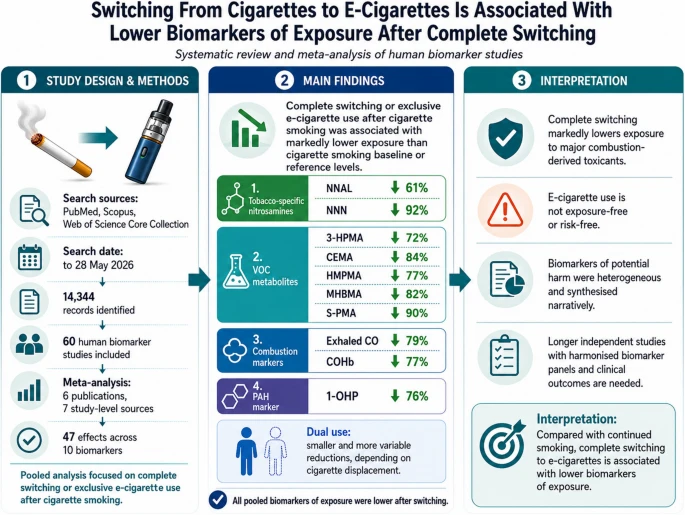
Researchers reviewed 60 studies. A smaller subset—six publications representing seven study-level sources—provided compatible data for a pooled analysis of ten exposure biomarkers. Every pooled estimate was lower after complete switching or exclusive vaping following cigarette smoking.
Selected findings included:
|
Exposure marker |
Approximate pooled reduction versus smoking |
|
NNAL, a marker of exposure to tobacco carcinogen NNK |
61% |
|
NNN, a tobacco-specific carcinogen |
92% |
|
S-PMA, a marker of benzene exposure |
90% |
|
Exhaled carbon monoxide |
79% |
These percentages describe changes in specific measured biomarkers. They are not percentages of reduced cancer risk or proof that vaping is safe.
For consumers, that distinction is essential. A headline saying “90% lower exposure to one chemical” should never become “90% safer overall.”
What these measurements offer is evidence about particular substances reaching the body—not a prediction of an individual’s future health.
Why removing cigarette smoke matters
The FDA explains that tobacco products carry different levels of risk. Combustible cigarettes are particularly harmful because burning tobacco creates a mixture of toxic chemicals.
E-cigarettes heat liquid to produce an aerosol rather than burning tobacco. That difference can reduce exposure to many chemicals associated with cigarette smoke, although vaping still carries risks and nicotine is addictive.
For someone who does not smoke or use nicotine, there is no health reason to start vaping. For an adult who already smokes, however, comparing vaping with continued cigarette smoking is a different question.
The FDA emphasizes that adults who switch need to replace cigarettes completely to obtain the full potential benefit. Continuing to smoke while vaping can leave substantial smoking-related risk in place.
The review has limits worth understanding
Results varied considerably between studies. Many switching studies were short, product-specific, and industry-funded; five of the seven pooled sources were industry-affiliated.
Dual users generally showed smaller exposure reductions, depending on how much smoking they displaced. Metal biomarkers were not included in the primary pooled analysis. The findings do not establish long-term safety or quantify reductions in disease.
Those limitations help explain why the findings should not be treated as a promise about every device, every liquid, or every person.
A useful consumer takeaway is to look beyond the largest percentage in a headline. Ask what researchers measured, which products they studied, and whether participants actually stopped smoking.
Exposure research and quitting research answer different questions
This review examined toxicant exposure. Whether vaping helps people stop smoking is a separate research question.
Cochrane’s living systematic review finds high-certainty evidence that nicotine e-cigarettes help more people quit smoking than nicotine replacement therapy, such as patches and gum.
That finding does not mean everyone who tries vaping will quit. It does mean there is evidence of a cessation benefit alongside the research examining exposure after switching.
The most useful goal is clear: getting cigarettes out of the picture.
This research adds information to that conversation. It deserves to be understood accurately, with its findings and limitations presented together.
For an adult who smokes, “not harmless” and “no meaningful difference from smoking” are very different statements.