
Posted by Alli Boughner on Sep 1st 2026
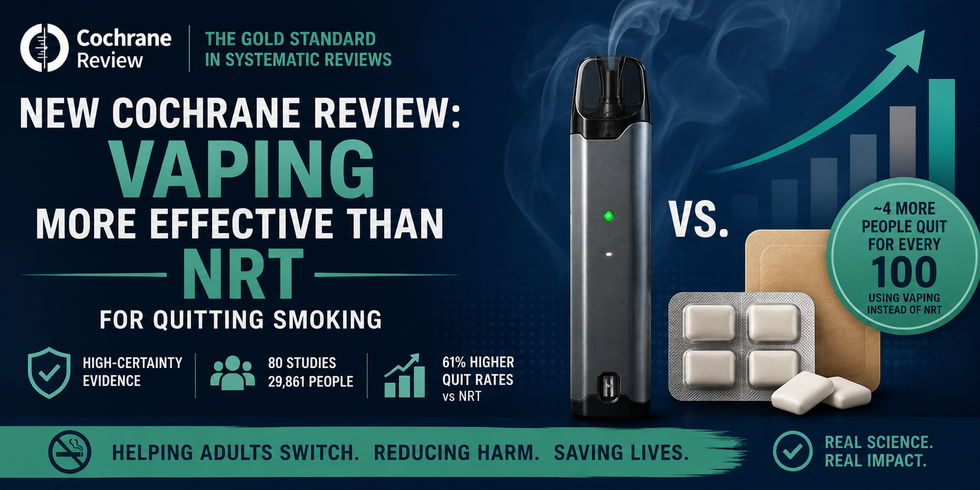
New Cochrane Review: Vaping More Effective Than NRT for Quitting Smoking
The evidence supporting vaping as a smoking cessation tool just got another major update — and the conclusion could hardly be clearer.
A newly published 2026 update from the Cochrane Database of Systematic Reviews, one of the most respected sources for systematic evidence reviews in medicine, concludes:
“There is high-certainty evidence that nicotine EC increase quit rates compared to NRT.”
In other words, after reviewing the available randomized evidence, researchers concluded with high certainty that nicotine-containing e-cigarettes help more adults quit smoking than traditional nicotine replacement therapy (NRT), such as nicotine patches and gum.
For an industry that has spent years hearing that we simply “don't know” whether vaping helps people quit smoking, this latest update deserves attention.
What Did the New Cochrane Review Find?
The latest review, Electronic cigarettes for smoking cessation, was published August 26, 2026.
This isn't one isolated clinical trial.
The updated analysis included 80 completed randomized controlled trials involving 29,861 participants, including nine RCTs that were new to this update. Researchers used established Cochrane methods and the GRADE framework to evaluate the certainty of the evidence.
The headline finding was the comparison between nicotine e-cigarettes and conventional nicotine replacement therapy.
Across 11 studies involving 4,114 participants, people using nicotine e-cigarettes had significantly higher smoking cessation rates than those using NRT.
The relative risk was 1.61, meaning quit rates were approximately 61% higher in the nicotine e-cigarette groups compared with NRT groups. Researchers classified this finding as high-certainty evidence.
That's important.
We're no longer talking about a weak signal suggesting vaping might help smokers quit.
We're talking about researchers assigning their highest level of evidence certainty to the conclusion that nicotine vaping increases smoking cessation compared with one of the most established smoking cessation interventions available.
What Does That Look Like in Real Numbers?
Cochrane's plain-language explanation makes the difference easier to understand.
For every 100 people attempting to quit smoking:
About 8 to 10 people using nicotine e-cigarettes may successfully quit, compared with around 6 using nicotine replacement therapy.
The statistical analysis estimated approximately four additional people quitting for every 100 people using nicotine e-cigarettes instead of NRT, although the confidence interval ranged from one to seven additional quitters.
Four additional quitters might not sound dramatic until you consider the scale of cigarette smoking.
Applied across thousands — or millions — of adults attempting to quit combustible cigarettes, even a modest absolute improvement in cessation rates can translate into a meaningful number of people no longer smoking.
Vaping Also Outperformed Non-Nicotine E-Cigarettes
The findings weren't limited to the NRT comparison.
Researchers also found moderate-certainty evidence that nicotine-containing e-cigarettes probably increase quit rates compared with e-cigarettes without nicotine.
Across seven studies involving 1,918 participants, nicotine e-cigarettes produced a relative quit rate of 1.34 compared with non-nicotine e-cigarettes.
The review also found that nicotine e-cigarettes may increase smoking cessation compared with behavioral support alone or no support, although researchers rated that evidence as lower certainty because of limitations in the underlying study designs.
Across the major comparisons, however, the direction of the evidence consistently favored nicotine e-cigarettes for smoking cessation.
What Did the Review Find About Adverse Events?
The safety findings deserve the same careful treatment.
The researchers found that serious adverse events were uncommon across the studies.
When comparing nicotine e-cigarettes with nicotine replacement therapy, there was moderate-certainty evidence that serious adverse-event rates were probably similar between the groups. Evidence regarding overall adverse events was less certain because of imprecision and inconsistency between studies.
The researchers said they did not detect evidence of serious short-term harm from nicotine e-cigarettes, while also emphasizing an important limitation: larger and longer trials are still needed to fully evaluate long-term safety.
That's an important distinction.
No credible harm-reduction argument requires claiming that vaping is harmless.
The relevant question for an adult who already smokes is whether switching to an alternative can reduce harm and improve the likelihood of leaving combustible cigarettes behind.
And when it comes specifically to smoking cessation, the evidence continues to strengthen.
This Isn't the First Time Cochrane Has Reached This Conclusion
Another important part of this story is that this isn't some sudden reversal.
The Cochrane review is a living systematic review, meaning researchers continually search for new evidence and update the analysis as additional studies become available.
Previous versions had already concluded that nicotine e-cigarettes increased quit rates compared with NRT.
The new 2026 update adds additional randomized trials and continues to reach the same fundamental conclusion.
In the updated analysis, the nicotine e-cigarette versus NRT comparison now includes 11 studies and more than 4,100 participants, with the evidence remaining high certainty.
Cochrane's researchers also run and screen searches monthly so that the review can continue incorporating new evidence as it emerges.
In other words, the evidence base is not standing still.
It's growing.
And the central conclusion has remained remarkably consistent.
Why “High-Certainty Evidence” Matters
The phrase high-certainty evidence shouldn't be glossed over.
Cochrane uses the GRADE system to assess how confident researchers can be that an estimated effect reflects the true effect.
So when the authors conclude there is high-certainty evidence that nicotine e-cigarettes increase quit rates compared with NRT, this isn't casual language.
It's the result of a structured evaluation of the underlying evidence.
Independent experts reacting to the new review have made the significance clear as well. Professor John Britton, Emeritus Professor of Epidemiology at the University of Nottingham, described it as further confirmation that e-cigarettes help smokers quit and do so more effectively than medicinal forms of nicotine replacement.
Meanwhile, U.S. Vapor Policy Continues Moving in the Opposite Direction
And this is where the disconnect becomes increasingly difficult to ignore.
While the scientific evidence supporting vaping as a smoking cessation tool continues to strengthen, independent vapor businesses across the United States are facing an increasingly hostile regulatory environment.
States are implementing restrictive product registries.
Flavor bans continue to be proposed and enacted.
Independent manufacturers remain trapped in a federal PMTA system that has produced remarkably few marketing authorizations.
Retailers are losing access to products.
And private platforms and service providers are creating additional barriers for vapor businesses.
All of this is happening while one of the world's leading organizations for evidence synthesis is telling us, with high certainty, that nicotine vaping helps more adults quit smoking than nicotine replacement therapy.
That should force policymakers to ask a very basic question:
What outcome are we actually trying to achieve?
If the objective is reducing smoking-related disease and death, then evidence about what successfully helps adults stop smoking should be central to tobacco policy.
It shouldn't be treated as an inconvenience.
The Evidence and the Policy Shouldn't Be Moving in Opposite Directions
Reasonable regulation and tobacco harm reduction are not opposing ideas.
Products intended for adults should be manufactured responsibly. Age restrictions should be enforced. Youth access should be taken seriously. Manufacturers should be held to appropriate standards.
But none of those goals requires pretending that all nicotine products carry the same risks or provide the same potential benefits to adults who smoke.
The 2026 Cochrane review adds to an increasingly substantial body of evidence showing that vaping can play an important role in helping adults leave combustible cigarettes behind.
And importantly, Cochrane's conclusions apply to regulated nicotine-containing e-cigarettes studied in the included trials. The authors specifically caution that illicit products or products containing other active substances may have different risk profiles.
That's another reason a sensible regulated vapor market matters.
The Bottom Line
The latest Cochrane review shouldn't be controversial.
It should be informative.
After evaluating 80 randomized controlled trials involving nearly 30,000 participants, researchers concluded there is high-certainty evidence that nicotine e-cigarettes increase smoking quit rates compared with nicotine replacement therapy.
In the direct NRT comparison, nicotine e-cigarettes produced approximately a 61% higher relative quit rate.
The evidence will continue evolving. Questions about long-term effects deserve continued research, and nobody should interpret these findings to mean vaping is risk-free.
But we also shouldn't continually move the goalposts when the evidence doesn't support the preferred narrative.
For adults who smoke cigarettes and are trying to quit, the evidence supporting nicotine vaping isn't disappearing.
It's getting stronger.
And tobacco policy should be willing to follow the evidence wherever it leads.