




FDA Signals Green Light for ZYN Modified Risk Status — A Turning Point for Nicotine Harm Reduction
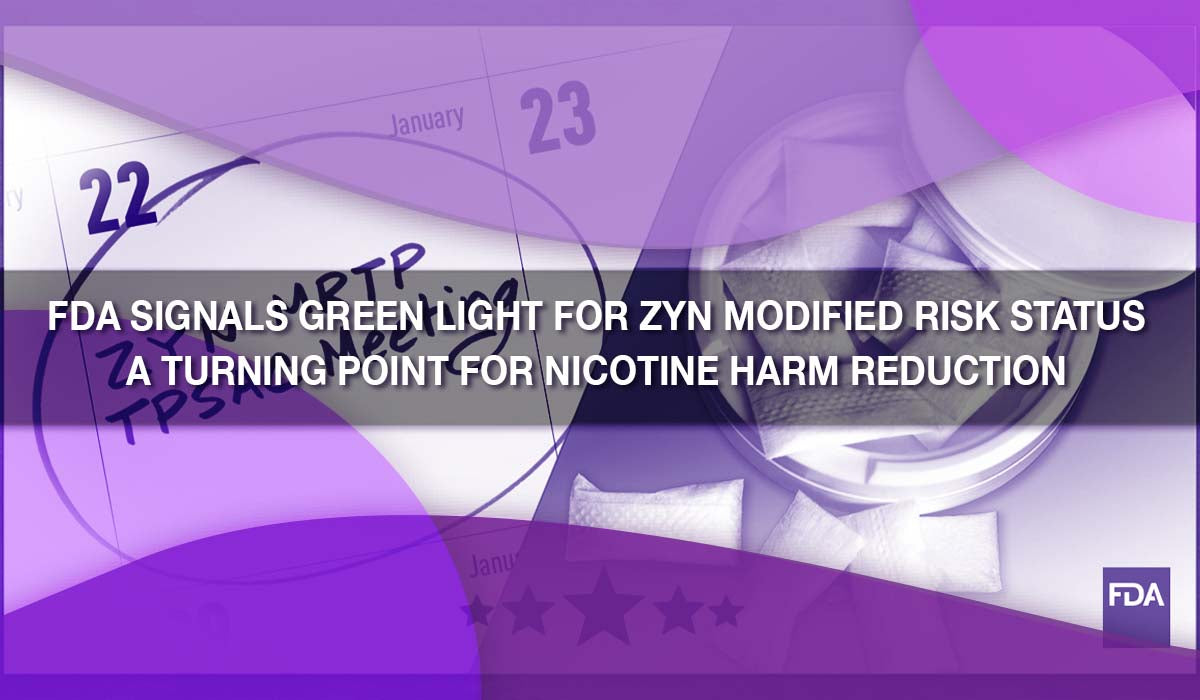
The U.S. Food and Drug Administration appear poised to take one of its most consequential steps yet in acknowledging tobacco harm reduction: authorizing ZYN nicotine pouches to be marketed as a Modified Risk Tobacco Product (MRTP).
At a January 22 meeting of the Tobacco Products Scientific Advisory Committee (TPSAC), FDA scientists told panel members that Swedish Match’s proposed reduced-risk claim for ZYN is “scientifically accurate.” That single sentence carries enormous weight—not just for Philip Morris International (PMI) and its Swedish Match subsidiary, but for the future of smoke-free nicotine alternatives in the United States.

If finalized, the decision would allow ZYN to explicitly state that switching from cigarettes reduces the risk of six major smoking-related diseases, including lung cancer, heart disease, stroke, emphysema, chronic bronchitis, and oral cancer.
For years, public health experts, clinicians, and harm-reduction advocates have said this out loud. Now, federal regulators are preparing to do the same.
From PMTA to MRTP: The Next Regulatory Milestone
ZYN is no stranger to FDA scrutiny. In January 2025, the agency authorized 20 ZYN products through the premarket tobacco product application (PMTA) pathway—the first nicotine pouches ever to receive such approval.
That earlier decision acknowledged two critical facts:
- ZYN contains dramatically lower levels of harmful chemicals than combustible cigarettes and many traditional smokeless products.
- A significant portion of adult smokers who used ZYN switched completely away from cigarettes.
The current MRTP review goes further. While PMTA authorization allows a product to be sold, MRTP status allows it to communicate relative risk—something the FDA has historically been extremely cautious to permit.
Swedish Match’s proposed statement is straightforward:
Using ZYN instead of cigarettes puts you at a lower risk of mouth cancer, heart disease, lung cancer, stroke, emphysema, and chronic bronchitis.
According to FDA scientists, the data supports that claim.
That is not routine language in FDA proceedings. MRTP applications are evaluated under one of the strictest standards in tobacco regulation, requiring both scientific accuracy and a demonstration that the marketing would benefit public health at the population level.
Why This Matters Beyond One Brand
If granted, ZYN would join a very short list of products legally allowed to make reduced-risk claims in the U.S.
More importantly, the decision would signal that U.S. regulators are becoming more willing to publicly distinguish between combustion and non-combustion nicotine products—a distinction that researchers have emphasized for decades.
FDA briefing materials presented to TPSAC highlighted:
- Substantially lower levels of harmful and potentially harmful constituents (HPHCs) in ZYN compared to cigarettes
- Biomarkers of exposure that were lower—or in some cases undetectable—among pouch users
- Toxicological profiles consistent with reduced disease risk when smokers switch completely
In other words: less smoke, fewer toxins, lower risk.
That is the foundation of harm reduction.
Scientific Agreement, Behavioral Uncertainty
TPSAC members did raise legitimate questions—not about whether ZYN is safer than cigarettes, but about whether reduced-risk messaging changes behavior at scale.
Some panelists noted that proving a product is less harmful is not the same as proving that marketing language will cause large numbers of smokers to switch.
That uncertainty is real. But it is also unavoidable.
Regulatory policy often demands perfect evidence before allowing truthful communication, while cigarettes—still the most lethal consumer product in history—remain freely sold with minimal comparative context.
As one panelist bluntly noted: there are very few legal products worse for you than cigarettes.
Youth Use: The Other Half of the Equation
MRTP authorization does not hinge solely on adult benefit. The FDA must also determine whether allowing reduced-risk claims is “appropriate for the protection of the public health,” including potential effects on youth and non-users.
Here, the agency’s own data cuts against many alarmist narratives.
Using 2024 National Youth Tobacco Survey results, FDA researchers reported:
- 1.0% current use among middle school students
- 2.4% among high school students
They also found that exposure to the proposed reduced-risk claim did not increase interest in using ZYN among young adults.

That does not mean youth concerns are irrelevant. Advocacy groups warned about social media trends, flavored products, and discreet use. Comparisons to the Juul era were raised repeatedly.
But the current evidence does not show anything remotely resembling the explosive youth uptake seen in the vaping market circa 2017–2019.
Public health policy must weigh actual data, not just hypothetical risks.
The Market Impact Will Be Massive
ZYN already dominates the U.S. nicotine pouch category.
According to recent Nielsen data analyzed by Goldman Sachs, the brand generated more than $3.24 billion in U.S. sales last year, accounting for over two-thirds of the entire pouch market.
MRTP status would unlock something far more powerful than retail authorization: the ability to communicate why switching matters.
That is not just a marketing advantage. It is a public health message millions of adult smokers have never been allowed to hear clearly from regulated sources.
With cigarette volumes continuing their long-term decline, nicotine pouches represent one of the fastest-growing alternatives in the American market. Regulatory clarity could accelerate that shift dramatically.
A Quiet but Historic Shift
The FDA is not required to follow TPSAC’s input, and no formal timeline exists for a final decision. But the tone of the agency’s own presentation suggests that the outcome is largely predetermined.
If ZYN receives MRTP authorization, it will mark:
- The strongest federal acknowledgment yet that not all nicotine products carry equal risk
- A validation of decades of harm-reduction research
- A potential blueprint for how future smoke-free products are evaluated and communicated
It will not end controversy. It will not satisfy prohibition-minded activists. And it will not eliminate the need for youth protection.
But it may finally bring U.S. tobacco regulation closer to an evidence-based reality.
Flavored Vapor Products are Not Available for purchase in the state of California


Leave a comment
This site is protected by hCaptcha and the hCaptcha Privacy Policy and Terms of Service apply.